
An autumn clean up is not one job. It is a handful of jobs with different deadlines, and the order you book them in matters more than the total. Book first the ones that have a real deadline: the last tidy trim of a deciduous hedge, leaves lying on lawns and paths, and overgrown ground you want cleared before spring. Perennial cut-backs, most pruning and a lot of the rest can wait. This guide sorts nine common jobs by timing using Royal Horticultural Society (RHS) and RSPB advice, sets out what 2026 price guides and a Gorton directory say it costs (none is an RGMS price), works a sum through and covers where garden waste can go. For the whole list priced from photos, our garden care quotes are free.
What to book first, in order
Three questions sort any autumn job. Is there a date after which it stops being a good idea, set by the weather, the season or the law? Does leaving it do damage, such as smothered grass? Or is it only about looks? Deadline jobs go first, damage jobs second and looks last. The table applies that to nine common jobs.
| Job | Why the timing matters | When to book |
|---|---|---|
| Last tidy trim of a deciduous hedge | The RHS calls October the last chance to trim deciduous hedges to keep them tidy over winter. The RSPB advises cutting only between 1 September and 28 February | Now, with a nest check first |
| Leaves on lawns, paths and steps | The RHS says to remove fallen leaves from lawns so they do not smother the grass. Leaves already in borders can be left | Start now, then every week or two while they fall |
| Overgrown ground you want back | Clearing in autumn or winter keeps work away from the March to September nesting season the RSPB describes | Book now for November to February |
| Spring-pruned shrubs and bush roses | The RHS says to cut shrubs such as Buddleja davidii back by half, and bush roses by a third, to stop wind rock | October or November, a short job |
| Bare-root hedging, trees and roses | The RHS says bare-root plants become available towards the end of October and are planted between November and March | Decide now, plant from November |
| Last mow and autumn lawn care | The RHS says to mow in mild weather above 7°C at a slightly higher cut, and to scarify and aerate only when the soil is not waterlogged or frosty | Now to November if conditions suit |
| Patio and path cleaning | Our patio cleaning guide covers the frost timing and the method for each surface | Before the first frosts |
| Cutting back perennials | The RHS says many gardeners wait until spring, because stems give wildlife food and shelter. Decaying or diseased growth can go now | Optional. Spring from March, unless the soil waterlogs |
| Pruning cherries, plums and almonds | The RHS says Prunus are vulnerable to silver leaf if pruned in autumn or winter | Leave until spring |
Three jobs are time-limited (the hedge, the leaves, the mow), two are worth deciding now (planting, overgrowth), and the rest are quick or better left alone.
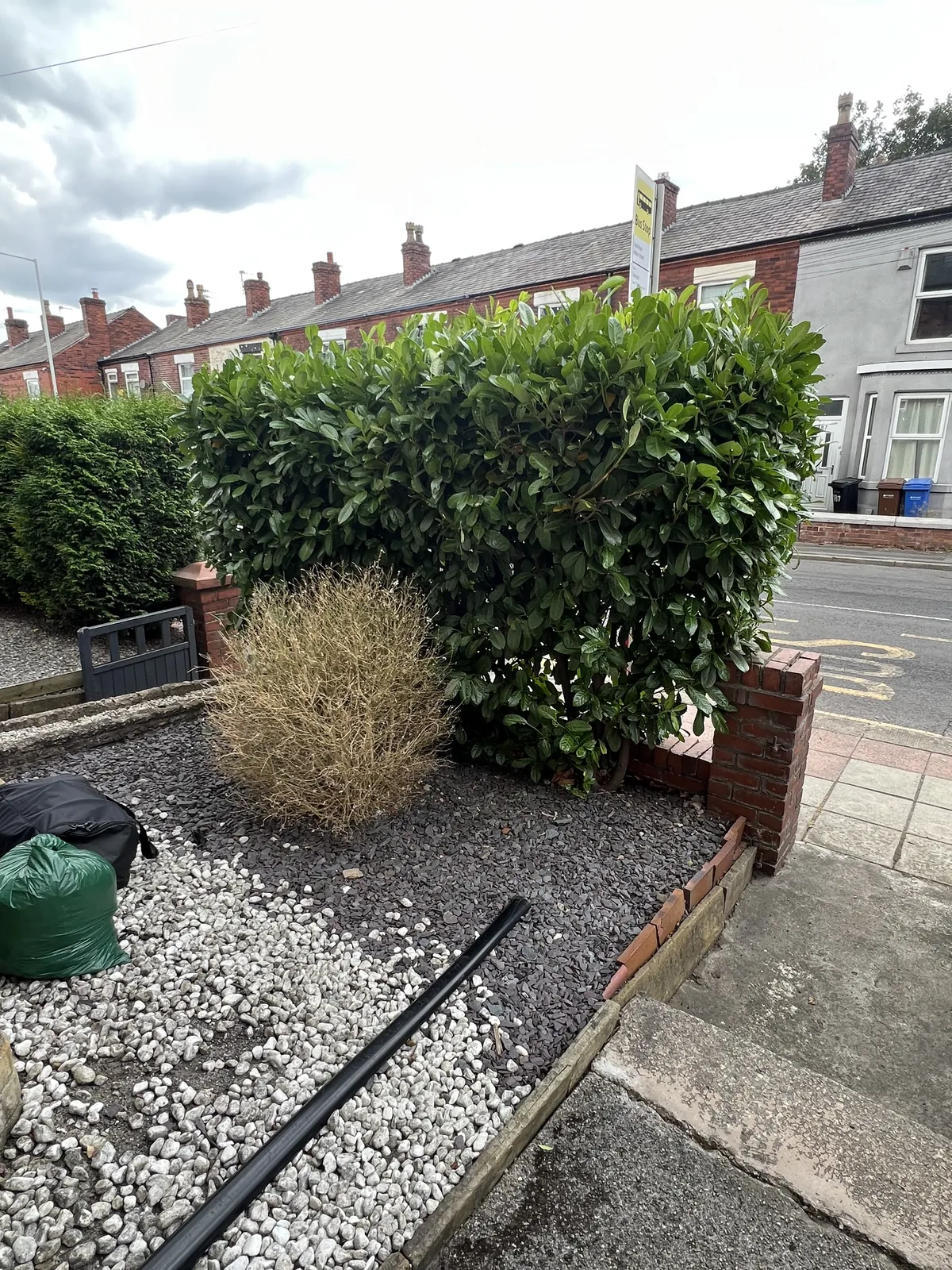
The hedge: deadline, and a rule that has nothing to do with the calendar
The RHS advises that October is the last chance to trim deciduous hedges, such as beech or hawthorn, so they stay tidy through winter. Its November advice adds that renovation pruning of many deciduous hedges can continue through the dormant season. That advice is about deciduous plants, so if your hedge is laurel or a conifer, ask the gardener what they would do and why.
The RSPB says March to September is the main nesting season and recommends cutting hedges only between 1 September and 28 February. It adds that some birds start nesting early, in January or February, or breed late into September, so a check is needed even inside that window.
The law works differently from the calendar. Under section 1 of the Wildlife and Countryside Act 1981 it is an offence to intentionally take, damage or destroy the nest of any wild bird while the nest is in use or being built. The RSPB points out that you can legally cut vegetation all year as long as no active nest is damaged. Its three steps are to watch the hedge for a few days for birds coming and going, to look through it thoroughly before cutting, and to use hand tools where you can, because they are easier to stop. When you ask for a hedge trim, ask how the nest check is done.
What you can leave alone
Many autumn checklists tell you to cut everything back. The RHS is more relaxed, and that matters if you are paying by the hour.
- Perennials. The RHS says cutting back in autumn tidies the garden, but removes winter structure and the food and habitat wildlife uses, so many gardeners wait until spring. A middle route is to cut only what is rotting or showing fungal growth now and leave the dry stems standing.
- Tender plants. The RHS says to leave woody-stemmed ones such as penstemons until the frost risk has passed, usually April or May, because the old stems protect the crown.
- Leaves in borders. The RHS says leaves that have already fallen on borders can be left. It is the lawn and the path that need clearing. Our leaf clearance guide sets out what to leave and what to bin.
- Cherries, plums and almonds. The RHS says to leave these until spring because autumn or winter pruning leaves them open to silver leaf.
- Some disease is the exception. The RHS says to rake up leaves with rose black spot or apple and pear scab and put them in the council green waste, not the compost, to reduce the problem next year.
A sensible quote lists what is being left as well as what is being done. If every plant is cut to the ground by Bonfire Night, ask why.
An overgrown garden is a different booking from a tidy
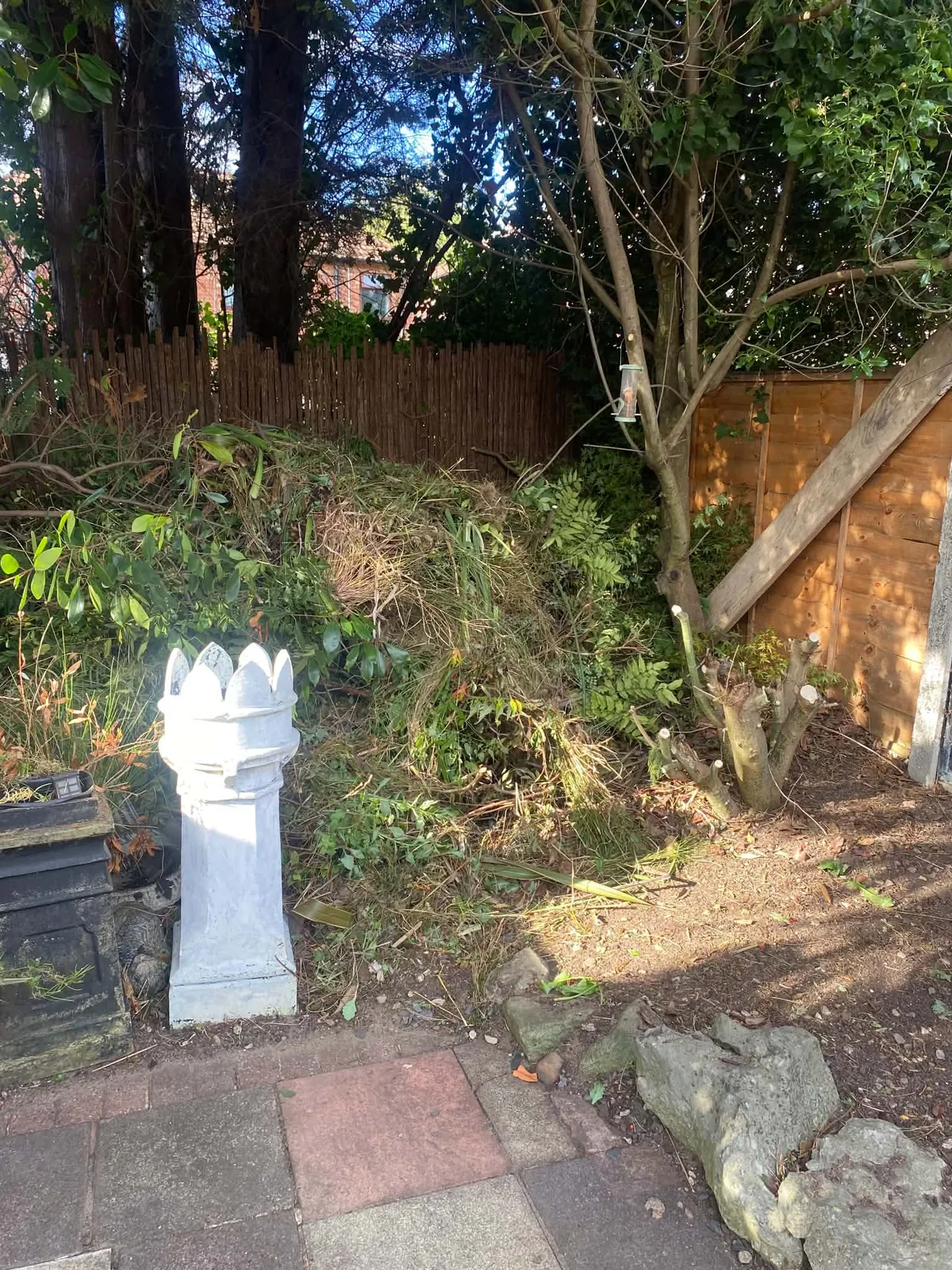
A routine tidy is mostly time: a hedge, the leaves, the borders. An overgrown garden is mostly waste. The cutting is only part of the work, and the removal is often the larger part, so the line on the quote to watch is what happens to the material. Our garden tidying service covers both, and its page says waste removal can be included and itemised in the quote.
If the ground has not been touched for years, treat it as a clearance and ask for a day rate or a fixed price, not an hourly rate with no ceiling. Our garden clearance cost guide explains what sets that price, and the overgrown garden case study shows a clearance done over three visits. For a garden that mixes both, put the hedge and leaves in the first visit so the deadline jobs do not queue behind the big one.
What the price guides and a Gorton directory say
None of these is an RGMS price or a quote for your garden. They describe different things, which is why they disagree.
| Source | What it says | What to note |
|---|---|---|
| Hamuch, Gorton gardeners (rates verified September 2026) | 20 listed gardeners at £27 to £35 an hour, about £31 on average by our count. A Gorton garden clearance estimate of £327 | The page says the rates exclude VAT and call-out charges |
| MyJobQuote, last updated 2 September 2026 | General gardener £14 to £25 an hour, about £20 on average. Hedge trimming £25 to £45 an hour and 1 to 2 hours. Clearance £100 to £200 fixed for 1 to 4 hours. Minimum call-out for small jobs about £25 to £35. Leaf blowing and collecting 30 to 60 minutes | A national average. VAT is not mentioned |
| Fantastic Services, 2026 guide | Clearance outside London and the South East: small £150 to £300, medium £300 to £600, large £600 to £2,000 or more. A team of two gardeners £83 for the first hour and £65 after. Green waste £5 for a black bag and £55 for a jumbo bag | The page says figures include VAT where applicable. Hourly rates are for two people, not one |
The gap between MyJobQuote’s £20 and the Gorton listings’ £31 is two different pools of prices: a UK-wide average and gardeners listed near Gorton this autumn. We cannot say which one a given firm will match. The gap to Fantastic Services’ £65 to £83 is that it prices two people.
A worked sum: a 4.5-hour autumn tidy
Take a terrace back garden and front hedge: the hedge (1.5 hours, the middle of MyJobQuote’s 1 to 2), a leaf and path clear (1 hour, the top of its 30 to 60 minutes) and border cut-back and weeding (2 hours, our own assumption). The rates are the lowest, average and highest in the Gorton listings. The figures are illustrative, not an RGMS price.
| Line | At £27 an hour | At £31 an hour | At £35 an hour |
|---|---|---|---|
| Labour, 4.5 hours before VAT | £121.50 | £139.50 | £157.50 |
| Labour with 20% VAT | £145.80 | £167.40 | £189.00 |
| Two jumbo bags of waste taken away at £55 | £110.00 | £110.00 | £110.00 |
| Total if VAT applies and waste is taken away | £255.80 | £277.40 | £299.00 |
| Total if no VAT and the clippings fit your green bin | £121.50 | £139.50 | £157.50 |
The same visit runs from £121.50 to £299.00, and the size of the garden is not what moves it. Three things do: the hourly rate, whether VAT applies and who takes the waste. GOV.UK gives the standard rate as 20% and says a business must register once its taxable turnover for the last 12 months goes over £90,000, so a one-person gardener often does not charge VAT. The £55 bag is Fantastic Services’ figure and already includes VAT where applicable, so it is not taxed again here. Ask every firm for the total you will pay, written down.
In Gorton: bins, tips and the waste question
Our Gorton area page describes Victorian terraces, family homes, rental properties and small commercial premises, with compact gardens and shared access routes.
- The green bin. Manchester City Council says the green bin is for food and garden waste, including grass cuttings, hedge clippings, twigs and branches. Recycle for Greater Manchester adds that twigs should be no thicker than your wrist and that soil is not accepted, so soil goes to a recycling centre. How much fits depends on your bin and how many collections you can spread it over, which is why waste is the line to ask about.
- The tip. Recycle for Greater Manchester lists Sandfold Lane (M19) and Ash Road in Droylsden (M43) among its centres, both open 8am to 6pm every day when we checked on 28 October, and says Reliance Street (M40) is temporarily closed for improvement works. Hours change with the season, so check before you go. Greater Manchester residents use the sites free, and a van, hired van, pick-up or twin-axle trailer needs a permit.
- Trade waste. The same service says the centres are for household waste only and that trade waste is strictly not allowed. So when someone is paid to clear your garden, ask where the material goes. “The tip” is not a complete answer.
- Burning. GOV.UK says household waste must not be burned if it causes pollution or harm, and a council can serve an abatement notice for a bonfire that causes a nuisance. On a terrace a bonfire is not a disposal plan.
- Narrow access. If bags have to go through the house or along a shared alley, say so. It changes the time on the quote.
- Rented homes. Who pays is a separate question, covered in our guide to who is responsible for the garden in a rented property.
| Waste route | What the sources say | What to ask or check |
|---|---|---|
| Your green bin | Manchester takes grass cuttings, hedge clippings, twigs and branches. Recycle for Greater Manchester says twigs no thicker than your wrist and no soil | Will the gardener leave clippings to go in the bin over time, or take them? |
| Recycling centre, yourself | Free for Greater Manchester residents. A van, hire van or pick-up needs a permit | Check the site is open and whether your vehicle needs a permit |
| Taken away by the gardener | Recycling centres refuse trade waste. GOV.UK’s duty of care code says waste must only be given to businesses authorised to take it | Ask for their registration number and look it up on the Environment Agency register |
How to compare two clean up quotes
A single price for “an autumn clean up” cannot be compared. Ask each firm for the same eight things in writing.
- The jobs, in order, with hours.
Hedge, leaves, borders, clearance. If it is a fixed price, ask what hours it assumes.
- What kind of hedge, and how nests are checked.
The RSPB says to watch the hedge and look through it before cutting. Ask what they do.
- What is being left for spring.
Perennial stems, tender plants and any cherry or plum. A quote that leaves nothing standing deserves a question.
- One person or two.
Hourly rates for two people can be double those for one.
- Where the waste goes and what it costs.
Your green bin, the tip, or taken away, and whether taking it away is extra.
- The waste carrier registration.
If waste is taken away, ask for the number and look it up on the Environment Agency register. GOV.UK says registration numbers start with ‘CB’.
- The total including VAT.
Or a statement that VAT does not apply. Not a bare number.
- Wet weather and access.
What happens when the day is too wet or frosty, and how bags will get out of a terraced property.
For regular visits through the winter rather than a one-off, see our guides to garden maintenance cost in Gorton and what a seasonal lawn visit includes, and for the DIY lawn version of these jobs, autumn lawn care. Our hedge services, weed control and planting projects pages list the work each covers, and a quote from garden care is free and based on photos.
Frequently asked questions
How much is a garden tidy up?
No source gives an RGMS or Gorton tidy-up price. Hamuch lists gardeners for Gorton at £27 to £35 an hour before VAT and a Gorton garden clearance estimate of £327. MyJobQuote, updated 2 September 2026, puts a general gardener at £14 to £25 an hour and a fixed clearance at £100 to £200. Fantastic Services puts a clearance outside London at £150 to £600 for small and medium gardens. Ask for hours, waste and VAT in writing.
How do I tidy a garden for autumn?
Start with the jobs that have a deadline: a last tidy trim of a deciduous hedge, clearing fallen leaves from lawns and paths, and one more mow in mild weather. Then do the short jobs such as cutting spring-pruned shrubs back by half to stop wind rock. Leave most perennials, tender plants and any cherry or plum until spring, as the RHS advises.
Is it okay to cut grass in October or November in the UK?
Yes, if the weather is mild. The RHS says to mow if necessary because grass keeps growing in temperatures above 7°C, and to raise the cutting height. It also says to avoid walking on a frosty lawn, which can leave brown footprints.
Can I cut a hedge in autumn?
Usually yes. The RHS calls October the last chance to trim deciduous hedges tidily, and the RSPB recommends cutting between 1 September and 28 February. Check for nests first, because some birds start early or breed late. It is an offence under the Wildlife and Countryside Act 1981 to damage a nest while it is in use or being built.
Where can garden waste go in Gorton?
Manchester City Council takes grass cuttings, hedge clippings, twigs and branches in the green bin, and Recycle for Greater Manchester says no soil and no twigs thicker than your wrist. Residents can use the recycling centres free, with a permit if they arrive in a van, hire van or pick-up. Trade waste is not allowed there, so ask a paid gardener where your waste goes and for their carrier registration number.
Should I cut back all my plants in autumn?
Not necessarily. The RHS says cutting back perennials in autumn tidies the garden but removes winter structure and wildlife habitat, so many gardeners wait until spring. It suggests removing only material that is decaying or showing fungal growth, and raking up leaves with diseases such as rose black spot into the council green waste.
Sources
- RHS, Gardening in October: jobs to do this month, checked 28 October 2026
- RHS, Jobs for October: trees and shrubs, checked 28 October 2026
- RHS, Jobs for November: trees and shrubs, checked 28 October 2026
- RHS, Perennials: cutting back, checked 28 October 2026
- RHS, Jobs for October: lawns, checked 28 October 2026
- RHS, Jobs for November: lawns, checked 28 October 2026
- RSPB, Birds nests and nestboxes: top tips to help nesting birds, checked 28 October 2026
- Wildlife and Countryside Act 1981, section 1, up to date on 28 October 2026
- GOV.UK, Garden bonfires: the rules, checked 28 October 2026
- Manchester City Council, Green bins, containers and boxes, checked 28 October 2026
- Recycle for Greater Manchester, Garden waste, checked 28 October 2026
- Recycle for Greater Manchester, Find a recycling centre, checked 28 October 2026
- Recycle for Greater Manchester, Van and twin axle trailer permit, checked 28 October 2026
- GOV.UK, Waste duty of care code of practice, checked 28 October 2026
- GOV.UK, Register or renew as a waste carrier, broker or dealer, checked 28 October 2026
- Environment Agency, Register of waste carriers, brokers and dealers, checked 28 October 2026
- GOV.UK, VAT rates, checked 28 October 2026
- GOV.UK, When to register for VAT, checked 28 October 2026
- Hamuch, Gardeners in Gorton: rates and job estimates, rates verified September 2026, checked 28 October 2026
- MyJobQuote, Cost of hiring a gardener, updated 2 September 2026, checked 28 October 2026
- Fantastic Services, Garden clearance cost, 2026 UK price guide, checked 28 October 2026